Scott Bessent Should Resign Over His Nvidia CEO Demand
Opinion: Treasury Secretary Scott Bessent told Nvidia's board to hire an outside CEO within days. That is interference no cabinet member should make.
By Terrence Holt
November 16, 2026
6 minute read
Opinion
On Sunday morning, a sitting member of the President's cabinet went on national television and told the board of a private, publicly traded American company whom it should hire as its next chief executive. Treasury Secretary Scott Bessent said Nvidia's directors "need to go outside the company" in their search for a new leader. He added that "they need a dramatic shake-up," and he gave the board and its outside counsel a deadline: answers "in the next 10 days."
No Treasury Secretary has the authority to make that demand, and none should want it. By making it on Sunday Morning Futures, Bessent crossed a line Treasury Secretaries have long observed: the government enforces the law against companies, but it does not pick who runs them. For that reason, Scott Bessent should resign.
What happened
The facts are not in dispute. On November 12, Nvidia's board announced in a filing with the SEC that Jensen Huang had resigned as president, CEO and director, effective immediately. Chief Financial Officer Colette Kress became interim CEO, Harvey C. Jones became the company's first-ever board chair, and the board said in plain words that it "will consider internal and external candidates" for the permanent job.
The resignation followed a board investigation into Huang's reported relationship with a tech executive suspected of being a Chinese intelligence source, and allegations that Nvidia chips reached China through shell companies in violation of U.S. export controls. Those allegations are serious. Nothing in this column suggests they should go uninvestigated.
Three days later, according to Fox Business, Bessent told viewers: "We will see if Nvidia intentionally ignored the warning signs of these shell companies, many of them in Singapore." He said he had "seen reporting that only 1% of the chips sold in Singapore remained in Singapore," without naming that reporting. Then came the instruction: "This makes me think that, as the board conducts a search for a new leader, that they need to go outside the company."
Axios reported that he went further, asking whether Nvidia had been "pressing these seemingly illicit sales to goose their revenues and their earnings?" and accusing the company of a "culture of noncompliance." Nvidia reports its quarterly results on Tuesday, November 17. The Treasury Secretary chose the 48 hours before that report to cast doubt, on air, on the quality of its earnings.
The demand had no legal home
Strip away the television framing and ask a simple question: under what power did the Treasury Secretary issue a 10-day deadline to a private board?
The answer is none. The United States already has an agency for each of the real questions in the Nvidia case, and none of them is the Secretary's personal judgment about who should be CEO.
| Question raised by the Nvidia case | Who is actually responsible | What the law lets them do |
|---|---|---|
| Did chips reach China in violation of export controls? | Commerce Department, Bureau of Industry and Security | Investigate, fine, deny export privileges, refer for prosecution |
| Were investors misled about where revenue came from? | Securities and Exchange Commission | Investigate disclosures, bring civil enforcement actions |
| Did anyone knowingly break federal law? | Department of Justice | Bring criminal charges in a court, with due process |
| Who should run Nvidia? | Nvidia's board of directors, answerable to shareholders | Hire and fire the CEO; shareholders elect the board |
| What is Treasury's role? | Treasury Department | Manage federal finances, sanctions (OFAC), chair CFIUS reviews of foreign investment |
Every row has a process, a standard of proof and a way to appeal. The Secretary's televised demand has none of those. It cannot be appealed because it is not an order. It cannot be ignored either, because it comes from the official who chairs the committee that reviews foreign deals, whose department runs the sanctions program, and who sits beside the President who sets trade policy toward the company's largest markets. A board that defies him does so knowing exactly who he is.
That is the problem with "jawboning" by a powerful official. The pressure works precisely because it is unofficial. It carries the weight of the state without any of the limits the law puts on the state.
The board had already said it would look outside
Here is the finding that should embarrass anyone defending Bessent's remarks. The board's own November 12 filing already committed to considering external candidates. The Financial Times reported, as relayed by Fox Business, that the board had approached Arm CEO Rene Haas, an outside executive, before Bessent ever spoke.
So the Secretary's demand added no information to the search. Its only effect was to tell a private board that the federal government now has a preference, and to say so publicly enough that any internal candidate will now start the job under a cloud put there by the Treasury Department. Bessent did not widen the board's options. He narrowed them, and he did it in front of the market two days before earnings.
Interference is becoming a habit
This would be easier to dismiss as a one-off remark if it stood alone. It does not. In August 2025, after the federal government took an equity stake in Intel, Bessent said the administration was exploring stakes in "other industries", and at the time ruled out doing the same with Nvidia. That reassurance meant something: it told investors the government knew where its role ended.
Fifteen months later, the same official is not buying shares in Nvidia. He is doing something that requires no money at all: telling its board whom to hire. A government that owns part of a company at least has a shareholder's vote. A government that steers a company's leadership from a television studio has no vote and no accountability, only leverage.
Republicans used to understand this better than anyone. The case against an industrial policy run by Washington was never only that bureaucrats pick badly. It was that once officials can reward and punish private firms outside the law, every firm learns to manage its regulators instead of its customers. Bessent's remarks teach every board in America that lesson.
Why resignation, and not an apology
A Treasury Secretary's words move markets; that is why the job demands restraint. Axios noted that Nvidia shares had already lost more than $1.2 trillion in market value since the scandal broke in late October, losses that land in the retirement accounts of millions of Americans. Into that market, the country's chief financial officer suggested, without evidence he was willing to name, that the company's earnings may have been "goosed."
If the evidence exists, it belongs in a Commerce enforcement action, an SEC complaint or a DOJ indictment, where Nvidia can answer it. If it does not, the Secretary has damaged a private company and its shareholders on the strength of "reporting" he would not identify.
Either way, the remedy for the Nvidia scandal runs through the agencies built to handle it, and through a board that answers to Nvidia's owners. It does not run through a cabinet member's preferences about who sits in the CEO's chair. An official who does not see that difference, and who said it on national television, has shown he does not understand the limits of his office. He should leave it.
What would change this view: a public statement from Bessent withdrawing the demand and committing Treasury to raise any evidence through BIS, the SEC or DOJ. As of publication, he has made no such statement.
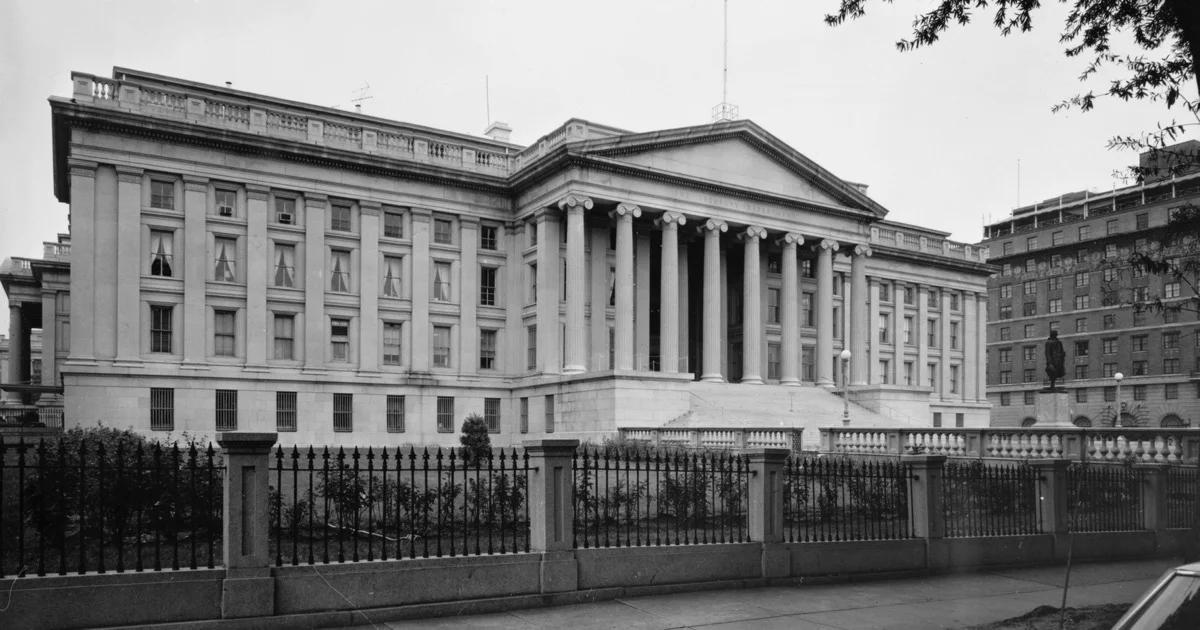
Cover: U.S. Department of the Treasury, 1500 Pennsylvania Avenue NW, Historic American Buildings Survey photograph, public domain, via Wikimedia Commons.