NDAA 2026: Tech Trends and Market Impacts

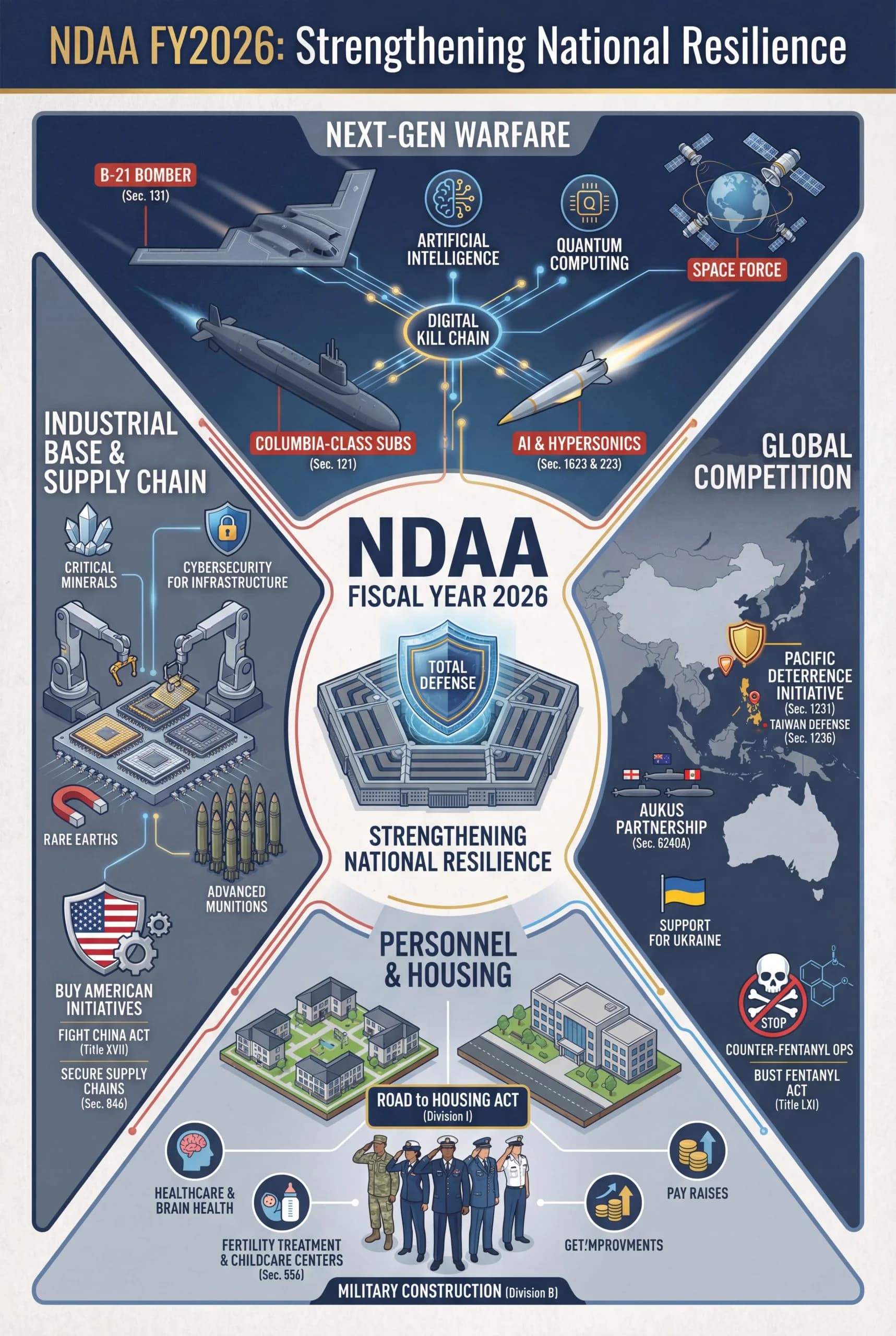
NDAA 2026 represents a watershed moment for how the United States coordinates defense priorities with technology development, procurement reform, and domestic industry resilience. Signed into law on December 18, 2025, the act authorizes fiscal year 2026 defense programs and sets in motion a broad slate of modernization efforts intended to accelerate delivery of warfighting capabilities while reforming the Pentagon’s budgeting and acquisition practices. In February 2026, Congress and the administration are evaluating early implementation signals—from rapid counter-UAS initiatives to sweeping changes in requirements governance—that will shape defense and tech markets for the next several years. The NDAA 2026 is not merely a line-item budget; it signals a deliberate blueprint for retooling U.S. defense planning around speed, accountability, and a more robust domestic industrial base. This article grounds the trend narrative in verifiable data points and real-world examples, drawing on official summaries, committee analyses, and industry commentary to illuminate what the NDAA 2026 means for technology markets, government buyers, and the broader economy. NDAA 2026 is the lens through which readers can interpret how defense policy shifts intersect with corporate strategy, supply-chain design, and consumer-facing tech ecosystems.
Section 1: What NDAA 2026 Is Changing
What’s Behind the Budget Shift
Big-Number Benchmark
NDAA 2026 operates within a complex budget backdrop. The Congressional Research Service notes that the NDAA for fiscal year 2026 covers roughly $882.6 billion in authorizations within the scope of the act, out of a President’s budget request near the $1.0 trillion mark for discretionary defense programs. The enacted version, per CRS analysis, sometimes exceeds the President’s request by a material margin, reflecting legislative balancing around priorities like force readiness, modernization, and modernization pathways. These figures illustrate that NDAA 2026 sits at the center of a high-stakes effort to reconcile ambitious modernization goals with fiscal discipline. (congress.gov)
Pay, Benefits, and Talent Retention
Amid modernization and reform, NDAA 2026 also embeds straightforward, high-signal workforce provisions. Several members of Congress highlighted a pay raise for service members—3.8%—as a core component of the act’s impact on personnel readiness and retention. The pay raise, along with other personnel provisions, is designed to sustain morale and competitiveness for a force operating in a rapidly changing threat environment. This is corroborated by congressional reporting and member statements accompanying the bill’s passage. (sewell.house.gov)
Counter-UAS and Homeland Defense Investments
A centerpiece of NDAA 2026 is the acceleration and expansion of counter-unmanned aircraft system (counter-UAS) capabilities, both in the field and in domestic readiness. The act advances a more centralized, cross-agency approach to counter-drone operations, including establishing authoritative coordination structures and streamlining procurement channels for rapid fielding. Industry and defense press have highlighted that this focus aligns with the rapid growth of small UAS threats seen in recent years and requires an integrated, fast-moving acquisition posture. (dronelife.com)
Acquisition Reform: From JROC to RAPID
A key governance transformation in NDAA 2026 is the modernization of the defense requirements process. Building on provisions often described as SPEED Act-inspired reforms, NDAA 2026 moves toward a portfolio-based, expedited decision framework that replaces or retools the Joint Requirements Oversight Council (JROC) with a Joint Requirements Council (JRC) and a new Requirements, Acquisition and Programming Integration Directorate (RAPID). In practical terms, this aims to deliver capability recommendations more quickly (targeting weeks to months rather than years) and to improve alignment between warfighter needs and acquisition execution. Legal and policy analyses document the scale and pace of this reform, including the intended schedule for RAPID-led assessments. (bhfs.com)
Real-World Examples That Signal Change
The counter-UAS shift is not a theoretical exercise. The Joint Interagency Task Force 401 (JIATF-401) has begun delivering tangible capabilities and organizational changes to execute NDAA-inspired priorities. In January 2026, JIATF-401 announced its first Replicator 2 purchases to bolster homeland drone defense, signaling a move from planning to procurement and deployment in months rather than years. A parallel development cited by DoD communications highlights updated guidance to counter drone threats in the homeland, reflecting an interagency push to integrate sensors, effectors, and mission command across services and agencies. These steps show NDAA 2026 in action at the field level, not solely on paper. (war.gov)
Stakeholders and Affected Parties
The NDAA 2026 ecosystem touches a wide set of actors: the Department of Defense (referred to in the act and in executive summaries as the primary spend and policy engine), the defense industrial base (manufacturers, integrators, and service providers), Congress (which provides budgetary and policy oversight), and, indirectly, consumers and taxpayers who ultimately bear the costs and benefits of modernization and reform. The executive branch explicitly frames the act as advancing a “Peace Through Strength” agenda while reforming budgeting and acquisition for greater efficiency and deterrence, a message echoed in White House statements accompanying the signing. (whitehouse.gov)
Table: NDAA 2026 Policy Shifts and Immediate Impacts | Policy Area | Change Under NDAA 2026 | Potential Impact | Early Example / Case | | Acquisition Reform | JROC to JRC; RAPID-led 30–60 day threat/scenario assessments; portfolio approach | Faster, more coherent decisions; potential oversight trade-offs | SPEED Act-inspired governance changes; RAPID framework (Brownstein analysis) (bhfs.com) | | Counter-UAS/ Homeland Defense | Centralized cross-agency counter-UAS authority; 10 U.S.C. § 199 establishing JIATF-401 | Accelerated fielding; stronger domestic defense and critical infrastructure protection | Replicator 2 acquisitions; updated homeland guidance (JIATF-401) (dronelife.com) | | Personnel and Benefits | 3.8% pay raise; enhanced support for military families and housing | Improved retention; higher morale; potentially higher demand for related services | Rep. Sewell summary of FY26 NDAA; House press release on pay raise (sewell.house.gov) | | Industrial Base & R&D | Emphasis on domestic manufacturing and rapid prototyping; modernization pathways | Strengthened supply chain; more domestic production of critical systems | DoD modernization posture; public briefings on industrial base reforms (SASC materials) (armed-services.senate.gov) |
Section 2: Why NDAA 2026 Is Playing Out Now
Threat Landscape Drives Reforms
The NDAA 2026 era emerges from a perception of an increasingly complex and dangerous international security environment. Senate Armed Services Committee leadership frames FY26 as a bipartisan response to a “dangerous world” with threats across multiple theaters and domains, including cyber and space. The bill’s rhetoric emphasizes deterrence, modernization, and the need to “reindustrialize” the defense arsenal—an explicit policy stance to strengthen U.S. capabilities against rivals while ensuring the United States can field advanced technologies efficiently. This framing aligns with the committee’s post-markup communications and public remarks. (armed-services.senate.gov)

Tech Maturation Meets Acquisition Reform
Technology is advancing faster than traditional defense procurement cycles, creating a friction between capability potential and delivery timelines. The SPEED Act-driven reforms embedded in the NDAA 2026 reflect a broader trend in which the Pentagon seeks to compress development-to-field timelines and empower rapid experimentation. Legal and policy analyses describe a transition from longer, risk-averse processes to speed-oriented governance that prioritizes “best value” and portfolio-level decisions. The combination of counter-UAS needs, accelerated procurement, and a more dynamic acquisition framework explains why NDAA 2026 is designed to move at the speed of relevance. (bhfs.com)
Bipartisan Momentum and Executive Alignment
The legislative journey of NDAA 2026 benefited from visible bipartisan collaboration and executive alignment around core priorities—modernization, cyber resilience, and industrial base strength. White House statements and Senate/House leadership commentary underscore a shared view that the act should empower the U.S. military while reforming the budget and processes around modern defense needs. This cross-branch alignment helps explain why the act could endure political friction and proceed to enactment. (whitehouse.gov)
Section 3: What NDAA 2026 Means for Business, Consumers, and Industry
Business and Supplier Impacts
Market Acceleration and New Procurement Pathways
With the introduction of RAPID and the shift toward a portfolio-based acquisition approach, defense contractors and technology vendors can expect shorter evaluation cycles and more direct engagement with program offices. Legal and policy commentaries emphasize that the reform is designed to shorten time-to-field while maintaining accountability, a balance that could favor nimble small and mid-sized firms capable of rapid prototyping and iterative delivery. The practical implication is a reoriented vendor landscape where speed, interoperability, and value propositions around “best value” take on greater importance. (bhfs.com)
Counter-UAS Market Growth and Constrained Innovation Cycles
The NDAA 2026’s counter-UAS emphasis creates a sizable opportunity for defense-tech startups and established players in sensors, drone defense, and electronic warfare. DoD and interagency bodies are coordinating to field modular, scalable solutions rapidly, as evidenced by JIATF-401’s procurement activity and the centralization of counter-UAS efforts. The market implications include a multi-year expansion of the homeland defense market, new procurement routes, and potential early-bird contracts for firms with ready-to-integrate capabilities. (war.gov)
Workforce Economics: Pay, Benefits, and Talent Flow
A concrete policy signal from NDAA 2026 is the 3.8% military pay raise, designed to bolster retention and recruitment in a competitive tech and defense labor market. For industry suppliers and services tied to personnel readiness (housing, childcare, family programs), this shift could influence demand for related services and partnerships with federal programs. While this is a domestic policy impact, it intersects with corporate human resources and compensation planning across the defense ecosystem. (sewell.house.gov)
Consumer and Industry-Wide Effects
Driving Domestic Innovation and Supply Chains
NDAA 2026’s emphasis on strengthening the defense industrial base is closely watched by corporate planners outside traditional defense sectors. The act’s signals about reliable, domestically sourced supply chains and accelerated procurement rhythms can ripple into civilian tech markets that rely on defense-grade hardware, components, and software architectures. Industry observers note that the modernization push—especially around electronics, AI-enabled decision support, and hardened cyber capabilities—could foster cross-pollination with consumer tech ecosystems as dual-use innovations mature. (armed-services.senate.gov)
Implications for Global Competitiveness
As the United States recalibrates its defense posture with faster acquisition cycles and a stronger domestic base, global suppliers and allied nations observe a market environment that rewards agile, integrated solutions. The NDAA 2026 framework thus becomes a reference point for international partners seeking to align with U.S. standards on interoperability, open architectures, and rapid capability insertion. Industry commentary and official communications both stress a deterrent, technologically advanced posture that could shape collaboration patterns, export controls, and technology transfer policies in coming years. (armed-services.senate.gov)
Industry Changes and Tech Ecosystem Shifts
The Counter-Drone Value Chain
The counter-UAS imperative is shaping a distinct value chain, from sensor fusion and detection to effectors and command-and-control integration. NDAA 2026’s acceleration of these programs has potential cost and performance implications for the entire ecosystem, encouraging partnerships across government, academia, and industry to deliver multi-layered defenses. Defense press and trade associations highlight that successes in this space will hinge on interoperable, modular systems and rapid feedback loops between operators and researchers. (defensenews.com)
Acquisition Reform as a Market Signal
Beyond specific programs, the governance reforms encoded in NDAA 2026—accelerated assessments, portfolio-wide prioritization, and streamlined decision rights—signal a broader shift in how the Defense Department interacts with the tech sector. This trend could encourage more adaptive contracting arrangements, pilot programs, and phased deployments that reduce long wait times for capable systems, aligning with industry preferences for predictable, repeatable procurement paths. (bhfs.com)
Section 4: Looking Ahead—6 to 12 Months of NDAA 2026 Impact
Near-Term Trajectories
Early Fielding and Pilot Deployments
Within the first 6–12 months after NDAA 2026 enactment, the defense ecosystem is expected to move from planning to initial fielding for several rapid-procurement priorities, particularly counter-UAS capability deliveries and pilot demonstrations under the RAPID framework. The JIATF-401 timeline and the first Replicator 2 purchases demonstrate a pattern of moving from concept to contract in short order, a trajectory likely to continue as agencies finalize implementing guidance and start joint demonstrations with contractors. (army.mil)
Market Emergence for New Providers
With the new requirements and procurement tempo, a market niche is likely to open for firms that can deliver modular, interoperable solutions on tight timelines. Startups and incumbents alike may pursue partnerships that align with the new governance processes, leveraging rapid prototyping and field-ready packages. The defense press landscape shows a growing appetite for diversified supplier involvement and accelerated evaluation cycles, a trend that could shape who wins subcontracts and strategic programs in the near term. (defensenews.com)
Opportunities for Preparation and Readiness
Strategic Vendor Positioning
For technology vendors, NDAA 2026 presents a strategic invitation to align product roadmaps with the act’s modernization priorities—especially in counter-UAS, secure communications, AI-enabled decision support, and trusted supply chains. Firms should invest in interoperable architecture plans, security and cybersecurity credentials, and demonstration-ready pilots that can be embedded into RAPID-led evaluation cycles. Industry commentaries and policy analyses stress the importance of aligning with best-value procurement logic while maintaining clear value propositions for defense buyers. (bhfs.com)
Workforce Readiness and Talent Pipelines
With a meaningful pay raise and broader workforce incentives, contractors and industry partners may face renewed competition for skilled staff. Building partnerships with universities, research centers, and government internship programs can help sustain a pipeline of qualified engineers and program managers who understand both defense needs and commercial tech ecosystems. The NDAA 2026 pay provisions underscore the importance of talent as a strategic asset for implementation efficacy. (sewell.house.gov)
Risk Management and Compliance
As acquisition governance becomes more streamlined, organizations should maintain robust compliance and program-management capabilities to avoid misalignment or schedule slippage in fast-moving programs. The combination of faster decision cycles and cross-agency integration requires disciplined risk management, clear performance metrics, and transparent reporting. Industry observers note that the transition to RAPID- and JRC-driven processes will demand disciplined governance to sustain pace without sacrificing oversight. (bhfs.com)
Closing: Key Insights and Takeaways
NDAA 2026 is more than a fiscal-year authorization; it’s a strategic blueprint for modern defense governance and a catalyst for rapid tech adoption within the defense industrial base. The act’s emphasis on acquisition reform, counter-UAS readiness, and a strengthened U.S. industrial base creates a unique market signal: speed and interoperability are now core performance criteria, and domestic capability is a strategic differentiator. As the 6–12 month horizon unfolds, expect measurable shifts in procurement timelines, intensified collaboration between government and industry, and a growing ecosystem of vendors that can deliver modular, secure, and rapidly fielded solutions. For business leaders, the imperative is clear: align product strategies with NDAA 2026’s modernization priorities, invest in capable talent pipelines, and build readiness for the new procurement reality that prioritizes speed with accountability.
In this new era, NDAA 2026 serves as both a policy beacon and an operating manual for navigating defense technology markets. The era of long, opaque procurement cycles is yielding to a more open, collaborative, and performance-driven approach—one that rewards speed, resilience, and demonstrable value. As federal agencies stand up the new RAPID and JRC structures, the most successful firms will be those that couple technical excellence with a disciplined understanding of the evolving regulatory and procurement terrain. NDAA 2026 thus marks a turning point: the market and the mission are converging around faster delivery of capable, secure, and domestically supported defense technologies.